
Trying to machine a hardened D2 tool steel punch with a traditional end mill is a recipe for broken tools and scrapped parts. The mechanical forces involved create stress, deflection, and heat distortion, compromising the final component. Wire EDM sidesteps these issues entirely. It's an electro-thermal, non-contact process that can achieve micron-level accuracy without inducing stress, leaving you with a perfect, burr-free edge every time.
This article breaks down how Wire EDM works, where it excels, and how it compares to other manufacturing methods. We’ll explore everything from the physics of spark erosion to the practical cost drivers, giving you the information needed to decide when to specify Wire EDM for your next project.
Key Takeaways
- Wire EDM can machine any material that is electrically conductive, regardless of its hardness.
- The process is non-contact, eliminating mechanical stress, chatter, and tool wear.
- It excels at creating complex 2D profiles, sharp internal corners, and tapered features.
- Accuracy is controlled through a series of roughing and "skim" passes, which refine the surface finish and dimensions.
- Key applications include tool and die components, aerospace parts, and medical devices.
How Wire EDM Works: Spark Erosion Principles and Machine Components
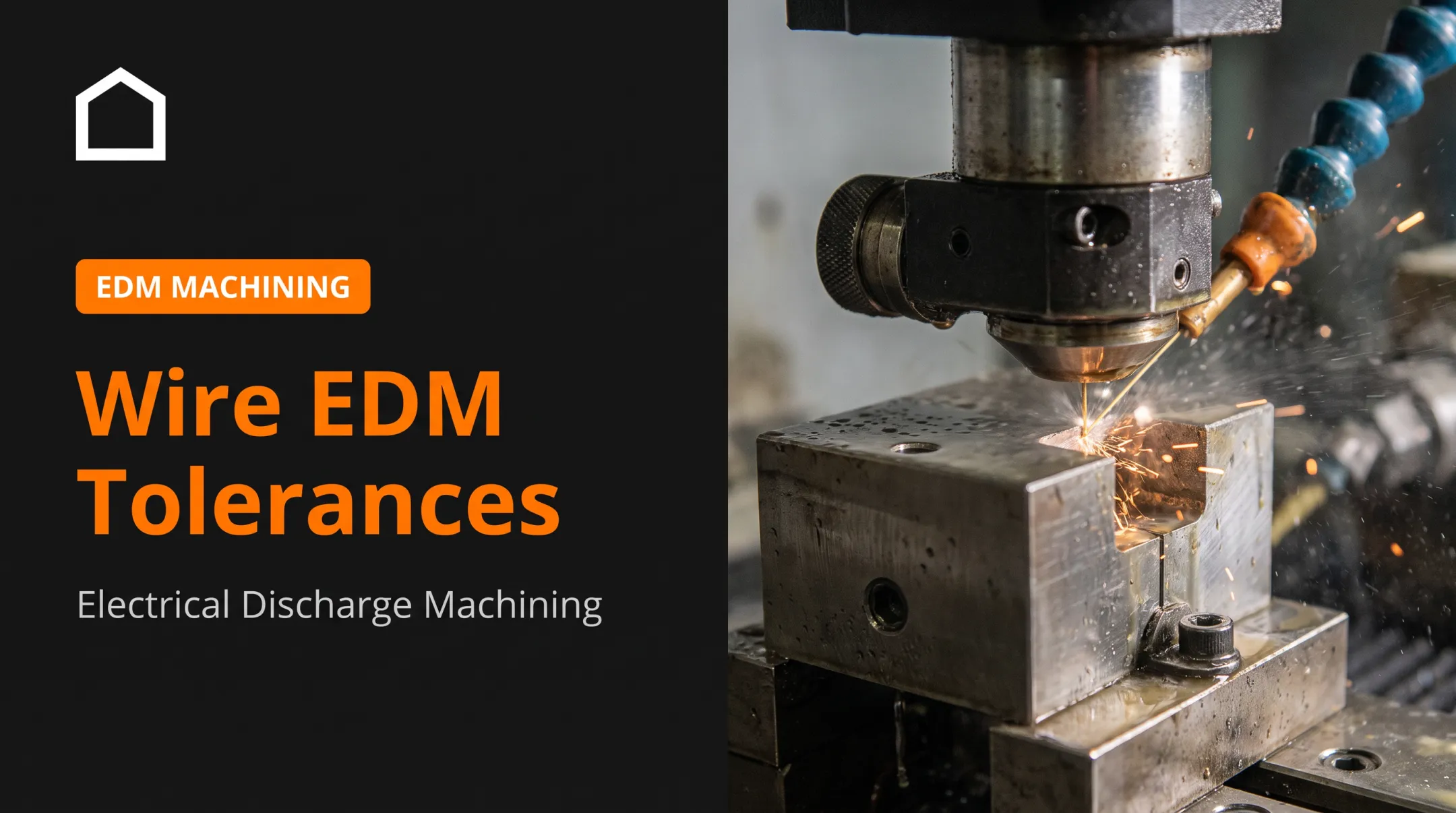
Wire EDM is a thermal cutting process. It uses a series of precisely controlled electrical sparks to erode material from a conductive workpiece. Unlike a CNC mill that uses physical force, a wire EDM machine never actually touches the part it’s cutting.
The process starts with a thin, continuously fed wire—typically made of brass—acting as an electrode. This wire is submerged along with the workpiece in a tank of deionized water, which serves as a dielectric fluid. A voltage is applied between the wire and the workpiece, creating a powerful electrical potential across the tiny gap separating them.
When the voltage reaches a critical point, it ionizes the deionized water and forms a plasma channel. That channel produces an intense spark with temperatures that can exceed 10,000°C, melting and vaporizing a microscopic particle of the workpiece.
The deionized water cools the cut and flushes vaporized debris away. This cycle repeats thousands of times per second, eroding material along the programmed path.
The key components enabling this precision include:
- Deionized water: Insulates until voltage breaks down, then conducts the spark; also cools the cut and flushes debris from the kerf
- CNC wire guidance: Diamond guides keep the wire straight; X/Y move the workpiece, while U/V shift the upper guide for tapers
- Constant wire spooling: Fresh wire feeds once through the cut onto a take-up reel, so the electrode stays consistent end to end
Breakdown of the Machining Sequence: Roughing vs. Skim Cuts
Achieving high precision with Wire EDM isn't a one-step process. It requires a primary roughing pass followed by one or more finishing "skim" passes.
- Roughing pass: Higher power and high-pressure flushing remove bulk material and cut the part profile quickly. The pass often drops a center "slug" and leaves geometry close, with a coarse surface finish.
- Skim passes: Lower power and gentler flushing remove a tiny amount of material on each pass. More skims tighten dimensional tolerance and improve surface finish.

Wire Types, Wire Properties, and Material Compatibility
The electrode wire is a critical consumable in the EDM process, and the right choice depends on the application's demands for speed, accuracy, and finish.
Primary EDM Wire Materials
- Plain Brass Wire: Standard choice for general-purpose toolroom cutting. Balances electrical conductivity, tensile strength, and cost.
- Zinc-Coated and Diffusion-Annealed Wires: Zinc coating boosts cutting speed—it vaporizes below the brass core, stabilizes the spark, and supports higher power settings. Best for thick stock and high-throughput jobs.
- Molybdenum and Tungsten Wires: High tensile strength and stiffness for micro-machining—fine-pitch slots, delicate features, and very small inside corner radii.
Wire performance hinges on a few measurable properties:
- Tensile strength
- Resistance to elongation (higher elongation suits extreme taper angles)
- Electrical conductivity
- Auto-threading compatibility with the machine
Compatible Workpiece Materials
The single most important factor determining if a material can be cut with Wire EDM is its electrical conductivity. Hardness and mechanical strength are irrelevant. That is why shops can cut hardened tool steel or carbide as readily as softer conductive metals—ideal for tool and die work.
Commonly machined materials include:
- Hardened Tool Steels (D2, M2, H13, A2, S7)
- Carbide
- Titanium
- Inconel and other superalloys
- Graphite
- Copper and Brass
- Conductive Ceramics
Wire EDM vs. Sinker EDM vs. Traditional CNC Machining
Wire EDM is part of a larger family of electrical discharge machining processes. "CNC" simply refers to the computer numerical control that guides the machine, so a wire EDM machine is a type of CNC machine. The real distinction lies in the material removal method.
Wire EDM vs. Sinker (Die-Sinking) EDM
While both use spark erosion, their applications serve different jobs.
| Feature | Wire EDM | Sinker EDM |
|---|---|---|
| Electrode | A thin, continuously moving wire | A custom-machined 3D electrode (often graphite or copper) |
| Geometry | Cuts 2D profiles and through-holes (like a bandsaw) | Creates 3D blind cavities, pockets, and complex shapes |
| Dielectric Fluid | Typically deionized water | Typically hydrocarbon oil |
| Common Use | Punches, dies, extrusion profiles, stripper plates | Molds, forging dies, complex internal features |
Wire EDM cuts a contour through a part. Sinker EDM sinks a shaped electrode into a part.
Wire EDM vs. CNC Milling and Turning
This comparison comes down to thermal energy versus mechanical force.
- Removal Mechanism: Wire EDM uses non-contact sparks to vaporize material. CNC milling and turning use a hardened cutting tool to physically shear chips from a workpiece.
- Material Hardness: Wire EDM is indifferent to hardness. CNC milling struggles with materials above approximately 60 HRC, requiring special cutters and slower speeds.
- Geometric Constraints: Wire EDM can create sharp inside corners limited only by the wire's radius plus the spark gap. A CNC mill's inside corner is limited by the diameter of the cutting tool.
- Stress and Burr: Wire EDM adds virtually no mechanical stress and leaves burr-free edges. CNC machining imparts cutting forces that can create stress and burrs that need secondary deburring.

Industrial Tooling, Die Manufacturing, and High-Precision Applications
Wire EDM is indispensable in high-stakes industries where precision and material properties are non-negotiable.
Tool and Die Production for Fastener Forming and Stamping
Wire EDM is a primary process here because it can machine tool steels like M2, D2, and H13 after heat treatment. Cutting in the hardened state eliminates the distortion and warping that often follow soft machining plus heat treat.
That capability supports precise cold heading and stamping components, including:
- Extrusion dies
- Blanking punches and trim dies
- Complete die progressions
- Replacement press components built to print
Specialty tooling providers like Quality FORM Tools use precision machining networks to supply custom cold header tools and related details, often finishing final geometry on hardened materials with wire EDM.
Aerospace and Defense Critical Components
Aerospace engineers routinely specify tough superalloys like Inconel and titanium. These materials resist conventional machining but cut cleanly on wire EDM.
A common job is cutting intricate fir-tree blade-retention slots in turbine disks. The stress-free cut is mandatory to protect component integrity under extreme operating loads.
Medical and Miniature Precision Devices
Medical devices keep shrinking while geometries grow more complex. Wire EDM manufactures surgical tools, orthodontic components, and delicate implants with burr-free edges and tight corner radii—requirements for parts that must perform safely inside the body.
Engineering Tolerances, Surface Finish, and Cost Drivers
Wire EDM results and project cost depend on tolerance targets, surface requirements, and a few process variables.
Achievable Tolerances and Surface Integrity
With multiple skim passes, wire EDM can hold very tight tolerances. Some machine manufacturers have demonstrated a pitch accuracy of +/-2 µm (0.00008") and a surface finish of Ra 0.32 µm (12.6 µin). In a practical job shop setting, tolerances of +/-0.0001" to +/-0.0002" are routinely achievable.
The thermal process leaves a thin "recast layer" (white layer) on the surface, with a small heat-affected zone (HAZ) beneath it. Final skim-pass energy controls how thick that layer gets.
For most tooling applications, it is negligible. On critical aerospace or medical parts, fine-finishing passes can minimize it, or secondary processes such as electropolishing can remove it.

Primary Cost Drivers in Wire EDM Operations
Unlike CNC milling, where cost tracks machine time and programming, wire EDM pricing follows different drivers. There is no standard hourly rate; every job is quoted on its specific requirements.
Key price drivers include:
- Material thickness: Thicker stock slows cutting speed and extends cycle time
- Total cut perimeter: The linear distance the wire must travel
- Number of skim passes: Each pass adds time; fine finish and tight tolerance cost more than a rough profile
- Start-hole preparation: If no start hole exists, a small-hole EDM driller must create one before threading
- Wire consumption: Specialty wire costs more than brass, and higher speeds use wire faster
For many jobs, unattended "lights-out" runs help offset cost, especially on parts with long cut times.
Frequently Asked Questions
What is wire electric discharge machining (wire EDM)?
Wire EDM is a CNC subtractive process that uses a thin, electrically charged wire electrode to cut conductive materials. Thousands of controlled sparks erode the material without physical contact.
What is the WEDM machining process?
A conductive workpiece is submerged in deionized water, and an electrode wire is threaded through a starting hole. CNC-controlled discharges erode a programmed path—first a fast roughing cut, then slower skim cuts for precision.
What is the difference between EDM and wire EDM?
Wire EDM is a type of EDM. General or "sinker" EDM uses a custom-shaped 3D electrode to burn a negative impression into a part, creating blind cavities. Wire EDM uses a continuous spooling wire to cut a 2D profile completely through a part.
What is the key difference between CNC and EDM?
CNC (Computer Numerical Control) is a control system that automates machine movement. EDM is a material removal process that uses thermal spark erosion. A wire EDM machine is therefore a CNC-controlled machine that uses the EDM process.
Which materials cannot be machined by EDM?
Standard EDM cannot machine non-conductive materials such as most plastics, glass, wood, and ceramics. The workpiece must conduct electricity for spark erosion to occur.
How much does wire EDM cost per hour?
There is no standard hourly rate for wire EDM. Jobs are quoted individually based on material thickness, cut length, tolerances, surface finish, and setup complexity. Request a detailed quote for your specific part.