
But "precision" isn't just a claim on a machine shop's website. A CNC lathe rated for tight tolerances can still produce an out-of-spec part if the drawing, fixturing, or inspection plan falls short. Precision comes from the whole system: dimensions, tolerances, material selection, surface requirements, and verification working together.
This guide breaks down what precision machining actually means, how the major processes differ, which materials fit which applications, and what to include in an RFQ so you get a part that performs the first time.
Key Takeaways
- Precision CNC results depend on programming, tooling, and fixturing—not machine specs alone.
- Treat accuracy, precision, and tolerance as distinct callouts on the drawing—never assumptions.
- Match milling, turning, grinding, or EDM to the part’s geometry, material, and tolerances.
- Strong RFQs include CAD, material/condition, quantity, GD&T, finish, and documentation needs.
What Makes a CNC Machined Part "Precision"?
Precision machining is the controlled removal of material—using CNC programming, cutting tools, and fixturing—to produce parts that hit specified dimensions and function correctly in an assembly.
Repeatability comes from process control: consistent tool paths, stable workholding, and verified setups run after run.
Accuracy vs. Precision (They're Not the Same)
These two words get used interchangeably, and that causes real problems when you read a quality report. NIST draws a clear line: accuracy is how close a measurement sits to its true value; precision is how consistently repeated measurements agree with each other.
A machine can cluster parts tightly (high precision) and still miss the target dimension entirely. Both need checking. A batch of shafts at 10.05mm instead of a required 10.00mm can be perfectly repeatable—and still unusable.
Tolerances Do the Real Work
Dimensional, geometric, positional, and form tolerances tell the machinist how much variation is acceptable. Call out tighter tolerances only where the part actually needs them:
- Dimensional tolerances — linear size (length, diameter, depth)
- Geometric tolerances — shape (flatness, roundness, cylindricity)
- Positional tolerances — feature location relative to a datum
- Form tolerances — surface irregularities independent of size
Unnecessarily tight tolerances slow programming, add inspection steps, and raise scrap rates. If a mounting hole doesn't need ±0.0005", don't call it out that way. You add cost without adding function.
Surface Finish and Verification
Tolerances alone don't make a part "precision" in service. Surface finish, burr condition, and concentricity decide whether a seal holds, a sliding fit moves freely, or a thread engages properly. A punch or die insert with an inconsistent edge wears faster and fails sooner in production.
Verifying precision takes calibrated equipment and a documented inspection plan—not a caliper and a guess.
Gauge repeatability and reproducibility (GR&R) studies separate measurement-system variation from actual part variation. That distinction matters when a "bad" reading is really a bad gauge. The ASQ GR&R guidance covers how operators, instruments, and repeated readings each add uncertainty.
Repeatability across part measurements often uses standard deviation: s = √[Σ(xᵢ − x̄)² / (n − 1)]. Three parts at 9.99mm, 10.00mm, and 10.01mm give a mean of 10.00mm and s = 0.010mm—a tight, repeatable result.
Capability indices like Cpk are a different calculation: they factor both spread and centering against the tolerance limits.
How Precision CNC Machining Parts Are Made
A precision part typically moves through several stages before it ships:
- Engineering drawing or CAD review
- Material verification
- CAM programming
- Workholding setup
- Machining
- Deburring
- Finishing
- Final inspection

Skipping any of these steps is usually where problems start.
Matching Process to Geometry
Different features call for different machines. Here's how the main processes typically break down:
| Process | Best-Fit Geometry | Notes |
|---|---|---|
| CNC Milling | Flats, pockets, slots, holes, contours, dies, fixtures | Handles complex prismatic shapes and multi-sided features |
| CNC Turning | Shafts, pins, bushings, threaded parts, fittings | Suited to rotational, cylindrical components |
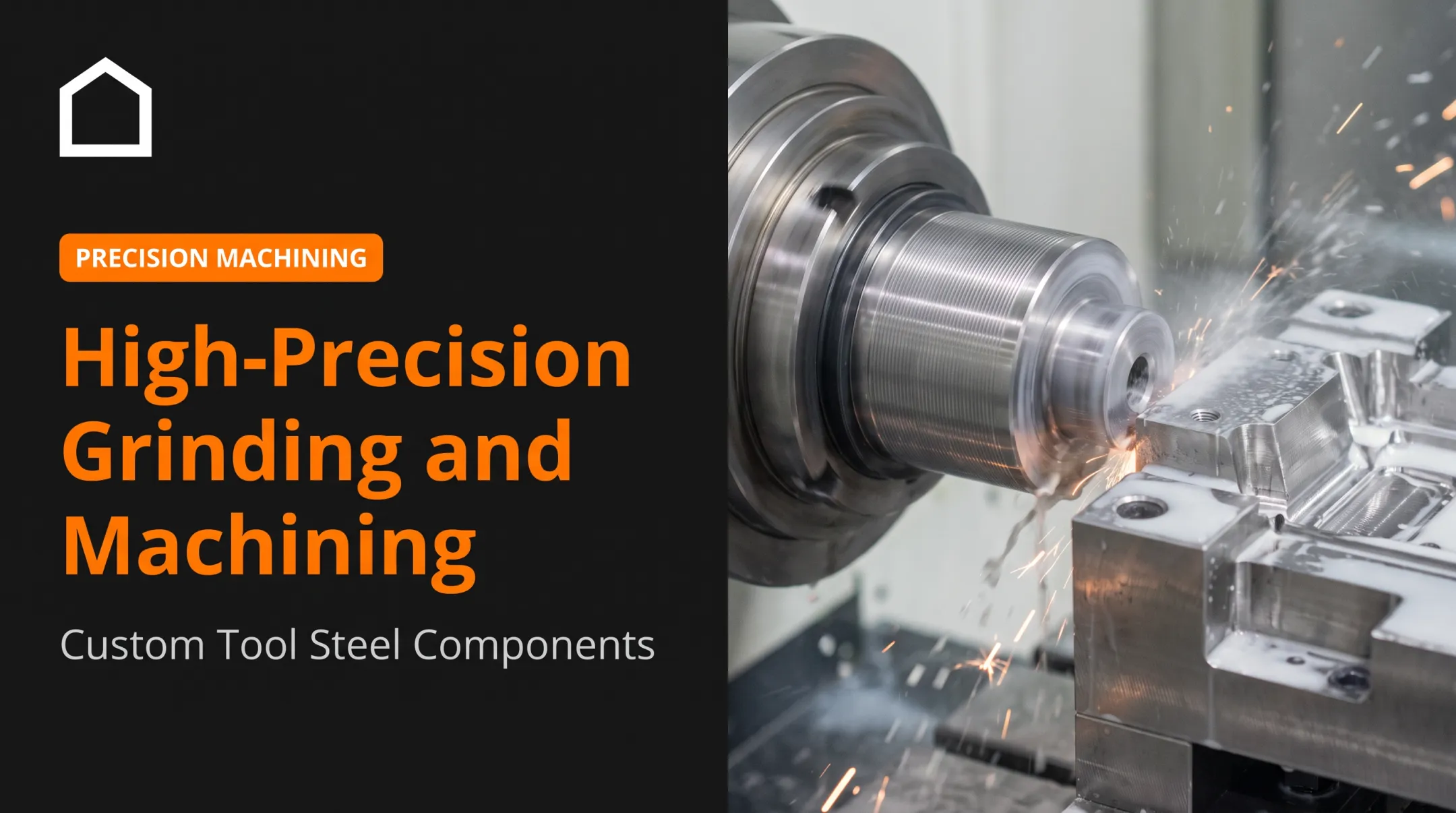
| Grinding | Dimensional refinement, fine surface finish | Often follows heat treatment for hardened parts |
| Wire/Sinker EDM | Hardened conductive materials, sharp internal corners | Reaches geometry milling can't access |
Wire EDM in particular shines on hardened tool steel where milling would chew through cutters fast, or where internal corners need to stay sharp instead of radiused.
What Actually Affects Repeatability
Several factors influence whether part number 500 matches part number 1:
- Machine rigidity and spindle alignment
- Tool wear and fixturing
- Thermal drift and vibration
NIST's research on machining error sources points to thermal gradients and dynamic vibration (chatter) as two of the more persistent culprits over a production run.
Fewer setups generally means fewer chances for repositioning error. Multi-axis machining can reduce the number of times a part gets unclamped and reclamped, according to Haas Automation's overview of five-axis milling. That said, the right machine still depends on the part's geometry and drawing requirements. Not every job needs five axes.
Secondary Operations and Volume
Heat treatment, plating, anodizing, passivation, and deburring often happen outside the primary machining step. Some shops handle these in-house; many outsource them. Confirm this directly with your supplier rather than assuming.
Production quantity changes the approach too:
- Prototypes and one-offs prioritize flexibility over dedicated tooling.
- Repeat production runs can justify fixture investment, process validation, and a formal inspection plan.
Quality FORM Tools sources CNC mill/turn, wire and sinker EDM, and hard turning/grinding after heat treat through its domestic and Taiwan-based supplier network. That same network supports prototype jobs and larger production volumes.
Common Precision CNC Machining Parts, Materials, and Applications
Precision CNC machining produces everything from everyday wear parts to specialty tooling. Shafts, pins, bushings, brackets, gears, fixtures, dies, punches, and replacement machine parts all show up regularly across industrial shops.
Organized by Application
Cold heading and fastener forming:
- Dies, punches, and cut-off tools
- Quills and feed-related tooling
- Wire draw dies and replacement components
Stamping and forging:
- Die components and inserts
- Press parts, guides, and fixtures
- Formed-part tooling
Industrial equipment and processing:
- Shafts, sleeves, and wear components
- Machine parts needing repair or replacement
- Custom production-line components
Quality FORM Tools sources and machines across this range, from complete cold heading tooling packages to metal stampings and forging dies.

Choosing the Right Material
Material selection depends on strength, hardness, corrosion resistance, wear behavior, machinability, and the part's operating environment. Tool steels dominate specialty tooling applications because they hold up under repeated impact and abrasion:
- M2 (high-speed steel): cutting tools, blanking, and cold-forming applications where edge retention matters
- D2: strong abrasive-wear resistance, used in blanking punches and coining dies, though it trades off some cracking resistance
- H13: hot-work grade built for thermal shock, common in forging tools exposed to repeated heat cycling
- S5: shock-resisting steel suited to heavy-duty punches and stamping dies
Quality FORM Tools machines tooling in M2, D2, H13, and S5. Confirm current grade availability and lead times when you request a quote, since sourcing can shift.
Critical parts, particularly in aerospace or automotive supply chains, may also require material certificates, heat-treatment records, or traceability documentation. Requirements vary by customer and contract, so check your specific sector's documentation standards before finalizing a quote.
How to Specify and Source Precision CNC Machined Parts
A vague RFQ produces vague quotes. Give your supplier everything they need up front and you'll get pricing that's actually comparable.
RFQ Checklist
- 2D drawing and 3D CAD file, with revision level clearly noted
- Material grade and condition (annealed, hardened, etc.)
- Quantity or forecast volume
- Critical dimensions and GD&T callouts
- Surface finish and edge requirements
- Heat treatment or coating specifications
- Inspection report requirements
- Packaging and delivery date
What Drives the Cost
Several factors push pricing up or down:
- Setup work: programming, fixturing, and workholding design
- Production inputs: raw material, machine time, labor, and outside processing
- Order specifics: quantity, repeat orders, expedited timelines, and tight tolerances
- Documentation: inspection reports and traceability paperwork add time
Tolerance, hardness, and quantity often swing price as much as the hourly rate. A 50-piece hardened 4140 run held to ±0.0005 in. will not quote like the same geometry in aluminum at ±0.005 in.

CNC shop rates also vary widely by region, machine type, and job complexity, and no single published national rate reliably captures milling, turning, and EDM work together. Ask for a rate breakdown specific to your job and region rather than assuming a flat hourly figure applies.
Questions Worth Asking Suppliers
Before committing, ask about:
- Relevant experience with your specific part type or material
- In-house process capability versus subcontracted operations
- Inspection methods and available documentation
- Lead times and minimum order quantities
- How they handle nonconformance and revision control
Comparing Quotes the Right Way
Unit price alone hides a lot. Compare these line items side by side:
- Setup charges
- Inspection scope and included reports
- Material certifications
- Finishing or secondary-op costs
- Who owns tooling and fixtures after the job
A lower unit price with a hidden setup fee and no inspection report often costs more over the life of the part.
Total cost also depends on whether the shop fits your volume. If you run smaller lots or an in-house tool room, confirm they will take one-off and replacement work—not only full production orders. Not every shop covers that range.
Quality FORM Tools for Specialty Machined Parts and Tooling
Quality FORM Tools is a Hammond, Indiana-based specialty tooling business that's worked with manufacturing customers since 2008. Through a network of domestic and Taiwan-based manufacturers, the company covers:
- Cold header tools and wire-form tooling
- Stamped and forged parts
- Machine parts and related tooling components
The team focuses on tight tolerances, competitive pricing, and reasonable lead times, backed by a "Fast-Ontime-Responsive-Manufacturing" approach.
If you need custom tooling, a replacement component, or a precision machined part for a low-, medium-, or higher-volume run, send a drawing or RFQ to get started. Confirm machining scope, material options, tolerance capability, and inspection documentation directly with the team, since specifics vary by project.
Reach Jeff White at jeff@doyouform.com or 877-368-3676 to review a drawing or discuss a sourcing need.
Frequently Asked Questions
How much does a CNC cost per hour?
CNC hourly rates vary by machine type, region, and complexity. Total job cost also covers programming, setup, material, and inspection. There's no single reliable national rate, so request a job-specific, itemized quote rather than comparing hourly figures alone.
What is precision machining?
Precision machining is controlled material removal, typically via CNC milling, turning, grinding, or EDM, that produces repeatable parts meeting specified dimensional, geometric, and surface requirements. It depends on process control as much as the machine itself.
What are some examples of precision components?
Common examples include shafts, pins, bushings, valve bodies, dies, punches, fixtures, gears, and replacement machine parts. These show up across fastener forming, stamping, forging, and general industrial equipment applications.
What is the formula for calculating precision?
There's no universal formula. Repeatability is often tracked with standard deviation across measurements, while process capability against tolerance limits uses metrics like Cpk. Which method fits depends on what you're measuring.