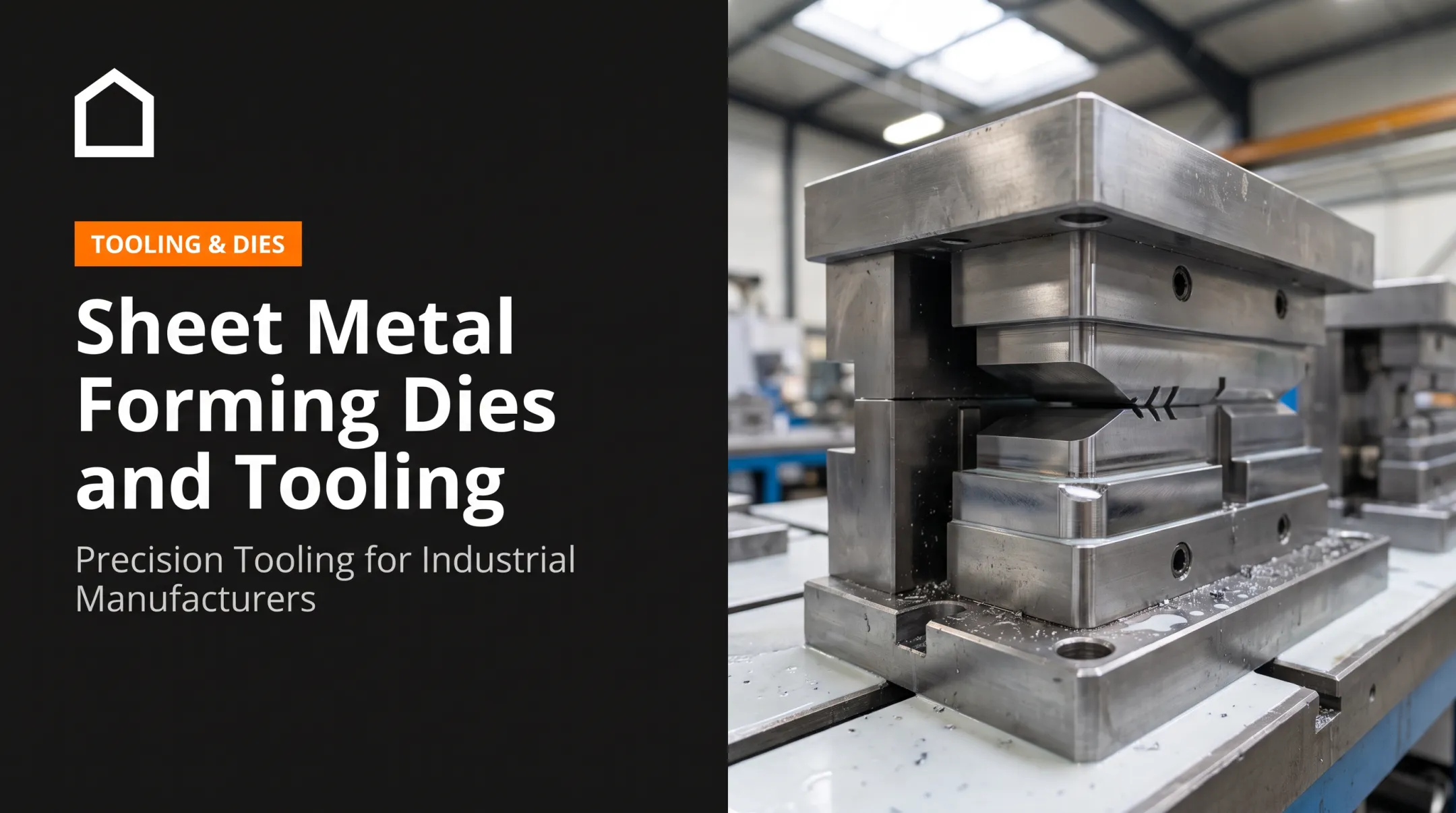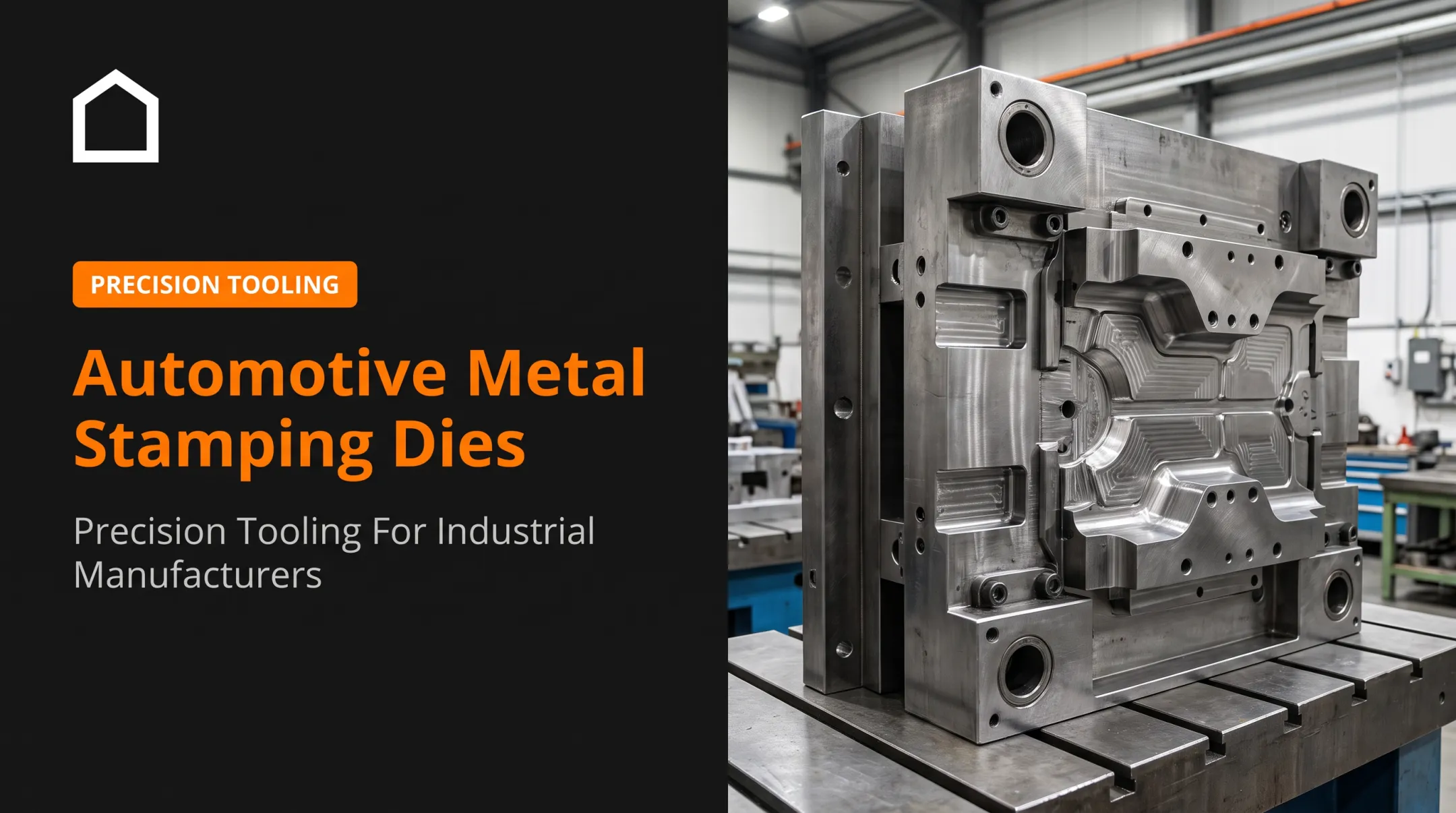

A forging die creates the shape. Forging tooling is the bigger picture: punches, inserts, holders, trim dies, fixtures, and the supporting equipment that keeps the whole operation running.
This guide breaks down die types, materials, design factors, and how tooling gets selected for a real production job. We'll also cover what manufacturers should include when requesting custom tooling from a supplier.
Key Takeaways
- Tooling selection depends on forging method, workpiece material, part geometry, volume, tolerances, and available equipment.
- Impression dies, open dies, and rolled-ring tooling each solve different shape and production challenges.
- Die material, heat treatment, lubrication, alignment, and maintenance directly affect wear rates and repeatability.
- A complete RFQ needs part drawings, material specs, quantities, machine details, tolerances, and existing tooling history.
What Are Forging Tooling and Dies?
A forging die is a hardened tool with a cavity, profile, or forming surface. It applies pressure to a billet, bar, preform, or slug and shapes that stock through plastic deformation: not by cutting material away, and not by pouring metal into a mold.
In closed-die forging, several elements work together:
- Upper and lower die — the two halves that close around the stock
- Parting line — where the dies meet
- Cavity — the impression that defines the part shape
- Flash land — a controlled gap that manages excess material flow and helps fill the cavity completely
- Gutter — the space that catches the extra material (flash) once it escapes the flash land
- Die holder — the block, often called a sow block on hammers, that protects supporting equipment from shock and wear
A casting mold receives liquid metal and lets it solidify. A cutting tool removes material. A forging die does neither. It controls how solid metal flows under pressure.
The Basic Production Workflow
A typical forging sequence looks like this:
- Stock preparation — cut billets or blanks to the required size
- Heating or conditioning — bring the workpiece to forming temperature, or leave it cold when the process calls for it
- Forming — deform the stock in the die under controlled pressure
- Trimming — remove flash with a separate trim die
- Inspection — verify critical dimensions and surface condition
- Secondary machining — finish features the die alone can't produce economically

Beyond the primary die, production tooling often includes punches for holes or recesses, replaceable inserts for wear-prone surfaces, trim dies for flash removal, and guides or holders that keep everything aligned.
What the Tooling Must Account For
Each of those elements has to handle:
- Material flow, draft, and radii
- Shrinkage and flash behavior
- Alignment and press capacity
- Part removal after forming
Miss any one of those and you chase dimensional problems on the shop floor instead of catching them on the drawing.
Types of Forging Tooling and Dies
Forging tooling falls into two classifications, and it's easy to mix them up. One classification is by tooling configuration: open, closed, rolled-ring, and so on. The other is by temperature: hot, warm, or cold forming. These describe different aspects of the same process, and a spec sheet should never conflate them.
Impression or Closed-Die Tooling
Matching impressions in opposing dies compress a billet or preform. This produces more complex, repeatable geometries than open-die work allows.
Flash does real work here, not just leftover metal. The flash land restricts material flow enough to build pressure and fill the cavity completely, while the gutter gives excess metal somewhere to go. Draft angles and radii keep the part fillable and ejectable without tearing or folding.
Impression dies suit:
- Recurring production parts with consistent geometry requirements
- Complex profiles that need tight shape control
- Connecting components and fastener-related parts
- Parts where controlled grain flow matters for strength
Open-Die Tooling
Open dies form the workpiece between relatively simple die faces: flat dies, blocks, saddles, mandrels, and punches. The operator or handling equipment controls positioning and deformation, rather than a cavity dictating the final shape.
This approach fits larger, simpler shapes and lower-volume work where building a full impression die wouldn't make economic sense.
Rolled-Ring Tooling
Rolls progressively reduce a punched or preformed ring in wall thickness while expanding its diameter. The main roll (often the outer-diameter roll) and a mandrel (the inner-diameter roll) shape opposing surfaces, and axial rolls control height where needed.
This produces seamless ring-shaped components used in flanges, bearing races, and other rotational parts, though additional machining is often still required to hit final tolerances.
Cold-Heading and Fastener-Forming Tooling
Cold header tooling looks different from general impression dies. A typical progression includes recess punches, heading dies, cut-off tooling, quills, feed rolls, and wire-draw dies, arranged as a sequence of stations rather than a single closed die.
That sequence has to match the part geometry, the wire or bar stock, the header machine, the number of forming steps, and the required production volume. Quality FORM Tools builds custom cold header tools, recess punches, and related fastener-forming tooling for customers who provide drawings or specifications. The tooling package is built around the actual job, not a generic template.

Forging Tooling Materials and Design Considerations
Choosing a die material is a balancing act. No single steel wins on every axis, so weigh these factors against the forging temperature and workpiece:
- Hot strength and toughness
- Wear resistance and thermal-fatigue resistance
- Machinability and grade fit for the process window
Common tool-steel categories used across forging and cold-forming applications include hot-work steels, cold-work steels, high-speed steels, and shock-resisting grades. Always verify the specific grade, heat-treatment condition, and application limits against authoritative material data before committing to a spec. Quality FORM Tools has experience working with M2, D2, H13, and S5 tool steels, each suited to different tooling requirements rather than one grade being universally "best":
| Steel | Typical Role | Producer-Cited Treatment Note |
|---|---|---|
| H13 | Hot-forging dies; resists heat checking | Air/gas/warm-oil quench, immediate double temper |
| D2 | Wear-resistant forming and trim tooling | Air/gas quench; a 500-550°F temper is cited to reach 58-60 HRC for that specific condition, per Hudson Tool Steel's D2 data |
| M2 | Punches and dies needing toughness over max hot hardness | Immediate double temper, sometimes triple for large or wire-EDM blanks |
| S5 | Heavy-duty, shock-loaded punches and mandrels | Oil quench typical, immediate temper for at least 2 hours |
Die Geometry and Material Flow
Draft, corner radii, fillets, parting line placement, cavity depth, and flash design all influence cavity fill, ejection, and stress at transitions.
According to FIA's Product Design Guide for Forging, ferrous forgings with less than 5 degrees of draft usually can't be produced on hammers. Press dies with knockout pins can often run with less draft, or none at all.
Geometry details that commonly drive rework:
- Sharp outside corners raise filling pressure
- Sharp internal fillets impede metal flow and can force an extra preform impression to avoid laps
- Small radius or parting-line shifts can change both manufacturability and die life
Map those choices visually before cutting steel.
Heat Treatment, Surface Condition, and Lubrication
Heat treatment has to match both the tool steel and the service conditions it will face. Hardness, toughness, dimensional stability, and crack resistance all trade off against each other depending on the temper chosen.
Lubrication does more than reduce friction:
- Supports proper material flow into the cavity
- Limits galling between the workpiece and die surface
- Helps control die wear over the production run
Lubricant families differ by process: graphite-based products for hot and warm forging, graphite-free options for certain steel applications, and polymer- or soap-based systems for specified cold-forming work. Research the process-specific recommendation for your application rather than assuming one lubricant works everywhere.
Alignment, Maintenance, and Replaceability
Die alignment, holder stiffness, cooling, inspection routines, polishing, regrinding, and planned replacement all factor into repeatable production. Replaceable inserts or modular tooling can cut maintenance disruption versus swapping an entire die when wear concentrates in predictable zones and changeover cost favors local replacement.
How Forging Tooling Is Selected for a Production Job
Start with the part drawing. Identify the required material, geometry, tolerances, surface requirements, critical features, and any machining allowance needed after forging.
From there, match the tooling approach to the job:
- Production volume: prototype, short run, recurring program, or high-volume line
- Tooling investment: full impression die versus open-die work the part can support
- Expected wear: cycle life and durability the run will demand
- Part complexity: whether geometry needs a matched-cavity die at all
Hot, Warm, and Cold: Choosing the Forming Temperature
Cold, warm, and hot forming each change ductility, dimensional control, work hardening, residual stress, oxidation, and achievable geometry.
Cold forming work-hardens the material and avoids scale, but it needs more force. Hot forming allows larger deformation, though it usually needs more finishing allowance. Warm forming sits between the two on force, scale, and dimensional control.

Always verify temperature ranges for your alloy from technical references. Do not apply one blanket number across materials.
Equipment and Manufacturability Review
Before quoting, a supplier should confirm equipment compatibility:
- Press or hammer type and available force
- Die envelope, stroke, and shut height
- Ejection method and transfer approach
- Heating system and lubrication setup
A thorough manufacturability review should also cover:
- Cavity filling and flash behavior
- Trimming access and die access
- Machining stock and inspection datums
- Where failure is most likely to show up first
RFQ Checklist for Custom Forging Tooling:
- 2D drawing and 3D model of the finished part
- Material grade and specification
- Initial and annual quantity estimates
- Machine make, model, and capacity
- Tolerances and surface finish requirements
- Details on any existing tooling
- Sample parts, if available
- Inspection requirements and acceptance criteria
- Delivery timeline expectations
- Packaging or marking needs
Quality FORM Tools works with forging shops, fastener manufacturers, and industrial buyers across the Midwest and beyond as a source for custom forging, stamping, cold-header, and replacement tooling. Send drawings and production requirements for a tailored job review, not a lead time quoted before anyone has looked at the print.
Forging Tooling Applications, Benefits, and Common Risks
Well-designed forging tooling shows up across fastener production, automotive and industrial components, stamping and forging press rebuilds, steel-processing equipment, and general production machinery. Quality FORM Tools supplies forging dies, metal stampings, and knockout pins & extrusion pins for these applications.
Benefits of solid tooling design:
- Repeatable part geometry run after run
- Controlled material flow that supports grain structure and strength
- Lower material waste than machining when near-net shape is realistic
- Reliable support for high-volume recurring production
Common tooling problems worth watching for:
- Premature wear or cracking, especially near flash-adjacent surfaces
- Galling from inadequate or mismatched lubrication
- Die shift — misalignment between the two impression halves causing part mismatch
- Incomplete filling or underfill, often tied to insufficient billet volume
- Excessive flash or dimensional drift over a production run
- Poor part ejection due to inadequate draft
One documented case from EWI's forging modeling research found that a lug feature failed to fill because the billet was too small. Increasing billet diameter solved the problem without any change to the die material. Diagnose the actual flow issue before assuming you need a harder steel.

Prevention comes down to a few habits:
- Verify the design before cutting steel
- Match tool steel and heat treatment to the actual duty cycle
- Control lubrication and temperature consistently
- Maintain die alignment and inspect critical features regularly
- Document maintenance findings so patterns show up over time
Even well-maintained dies have limits. Features like precise holes, threads, or tight-tolerance surfaces are often better handled with CNC machining, drilling, threading, or grinding after the forging step, rather than forcing the die to do everything.
Frequently Asked Questions
What is a forging die?
A forging die is the shaped, hardened tool that compresses a billet, preform, bar, or slug into the desired geometry. It differs from supporting tooling such as punches, holders, and trim dies.
What are the different types of forging dies?
Main categories include open dies, impression or closed dies, and trim dies, along with supporting punches and inserts. Specialty tooling like rolled-ring rolls or cold-heading progressions serve more specific applications.
What are the four types of forging?
One common classification lists open-die, impression-die (closed-die), rolled-ring, and cold forging. Forging can also be classified by temperature (hot, warm, cold) or by equipment type, so it helps to confirm which basis a given source is using.
What are forging dies made of?
Dies are commonly made from tool or alloy steels such as H13, D2, M2, or S5. The specific grade and heat treatment depend on forming temperature, load, wear exposure, toughness needs, and the workpiece material.
Which forging stock is currently the best?
There's no single best stock for every job. Selection depends on the part's function, required mechanical properties, forming temperature, process, material availability, and any downstream machining or finishing needs.
What is the most difficult metal to forge?
Forgeability depends on alloy, temperature control, geometry, strain rate, and equipment. Titanium and heat-resistant nickel alloys rank among the harder metals to forge and often need specialized process and tooling review.