
Introduction
CNC screw machining produces consistent, repeatable turned components at production speed. Despite the name, most shops running these machines haven't cut an actual screw thread in years — pins, bushings, shafts, and fittings make up the bulk of the work.
Choosing the right turning process for a small cylindrical or threaded part isn't always straightforward. You're balancing precision and volume, then setup cost, lead time, and which machine platform fits the job.
This article breaks down what CNC screw machining actually is, how the equipment operates, which parts and materials fit the process, and how it stacks up against other turning methods. You'll also see what to include in your quote request so suppliers can price the job accurately the first time.
Key Takeaways
- CNC screw machines turn bar stock into finished parts, often completing multiple operations in one cycle.
- Match the process to geometry, material, tolerances, quantity, and setup economics—not machine type alone.
- Evaluate suppliers on machining expertise, inspection practices, material experience, volume flexibility, and communication.
- Bring prints for custom tooling, machined parts, or forged/stamped components to Quality FORM Tools for review.
What Is CNC Screw Machining?
CNC screw machining is a subtractive process. A computer-controlled machine rotates a bar or rod while cutting tools remove material to shape a finished part. The result is a turned component built to a dimensioned print, not a hand-fit piece.
The name is a holdover from manufacturing history. According to the Precision Machined Products Association, the term traces back to an automatic screw-threading machine patented by Joseph R. Brown in 1865. Modern screw machines still produce threaded fasteners, but they're just as likely to turn out pins, bushings, shafts, fittings, connectors, and spacers.
Core Machine Elements
A typical CNC screw machine setup includes:
- Spindle: rotates the bar stock at the programmed speed
- Bar feeder: advances raw stock into the cut zone automatically
- Collets or workholding: grip the stock securely during cutting
- Tool stations: hold multiple tools for sequential or overlapping cuts
- CNC control: runs the program that governs tool movement
- Coolant system: manages heat and clears chips
- Part ejection: clears finished parts from the work zone
CNC vs. Cam-Operated Screw Machines
Older automatic screw machines relied on mechanical cams to drive tool motion. Changing jobs meant physically swapping and adjusting cam sets. CNC equipment replaces that mechanical programming with digital instructions, so job changeovers run faster and repeat setups stay more consistent.
CNC Screw Machining vs. Swiss-Style Machining
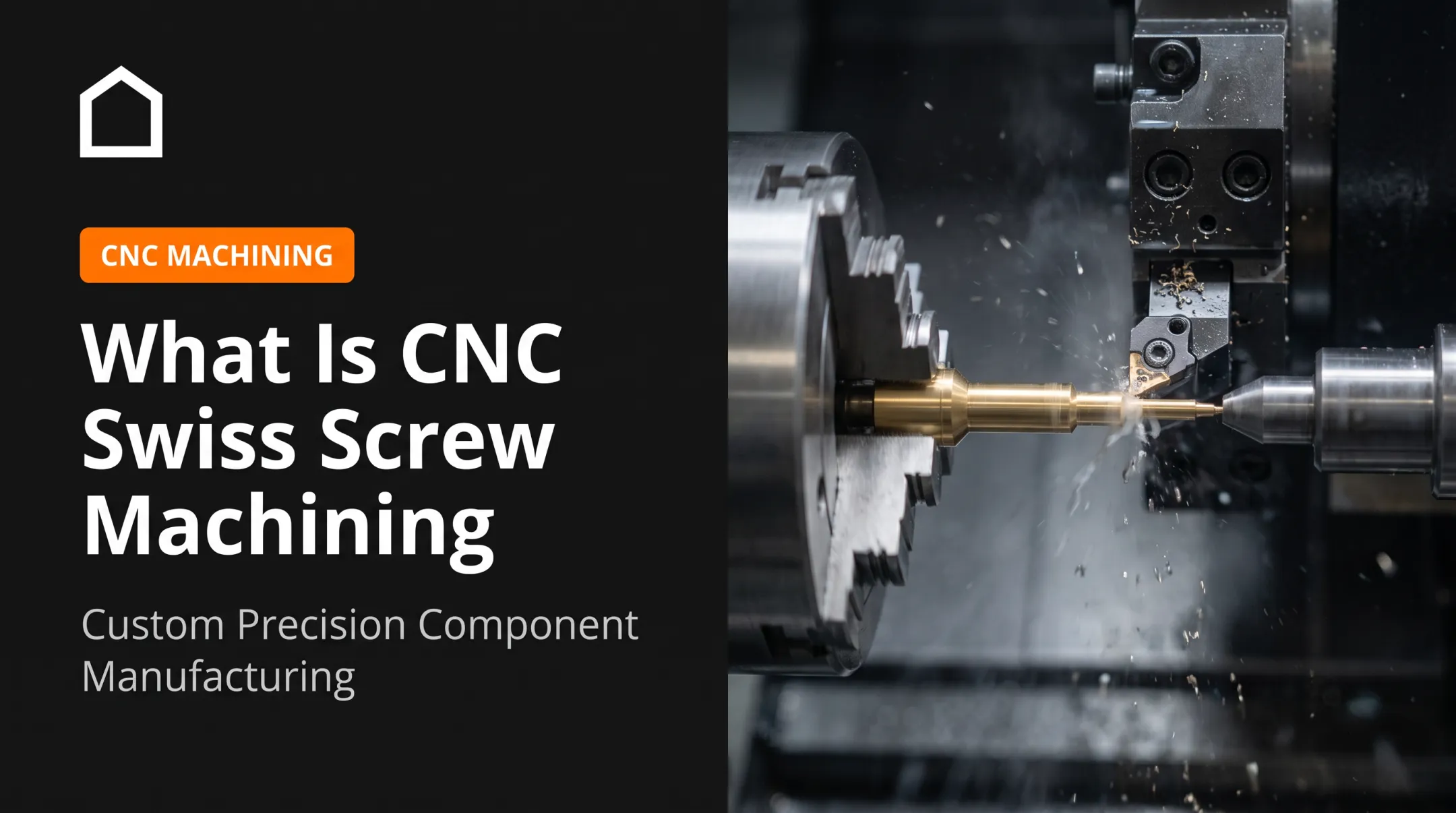
Both are bar-fed CNC turning processes, but they support the workpiece differently. A conventional CNC screw machine holds bar stock in a fixed headstock. A Swiss-style machine uses a sliding headstock that feeds bar through a guide bushing, supporting the material right at the cutting zone.
| Factor | CNC Screw Machining | CNC Swiss Machining |
|---|---|---|
| Best suited for | Standard-length turned parts | Long, slender, small-diameter parts |
| Workpiece support | Fixed headstock | Guide bushing near cutting point |
| Typical setup | Standard collet workholding | Sliding headstock configuration |
| Flexibility | Broad range of diameters and geometries | Strongest advantage on slenderness-limited parts |
Neither type wins every job. A technical comparison published by Cutting Tool Engineering notes that fixed-headstock machines can hold an edge on certain concentricity and position requirements, and they don't require bar-shaped blanks the way Swiss machines typically do. Choose Swiss when slenderness and small diameters drive the print; choose conventional CNC screw machining when diameter range, blank form, or position tolerances favor a fixed headstock.
How Does CNC Screw Machining Work?
The process starts well before the machine ever runs. Before a full production run, the shop typically:
- Reviews your part drawing or CAD file
- Confirms material specs and writes the CNC program
- Sets up workholding and tooling
- Runs a first-piece inspection
From Bar Stock to Finished Part
A bar feeder loads raw material into the spindle (or through the guide bushing on Swiss-style equipment) and advances it into position. The machine then establishes its work reference point before any cutting begins.
From there, a single setup can combine multiple operations:
- Turning and facing: shaping the outer diameter and squaring the ends
- Drilling and boring: creating internal features
- Threading: cutting external or internal thread forms
- Grooving, chamfering, and knurling: adding secondary features
- Cutoff: separating the finished part from the bar
Multiple tool stations, sometimes working on separate axes, can handle overlapping operations. That cuts how often a part is handled and keeps feature-to-feature relationships consistent. That consistency matters when a bore must stay concentric with an outside diameter across hundreds of parts.
Maintaining Quality Through the Run
Once those relationships are locked in, in-run process control keeps them there. Feeds, speeds, coolant flow, and chip control all affect surface finish and dimensional accuracy. Tool wear is a constant variable: a cutting edge that held tolerance at part 50 may drift by part 500. Shops that catch this early—with in-process checks or periodic sampling—avoid scrapping an entire run.

A simple example: Bar stock feeds into the spindle. The machine rough-turns the OD, finish-turns to size, drills a cross-hole, cuts a thread, and parts the piece off.
An inspector checks the first article against the print. Production continues, and finished parts collect in a bin or conveyor for final inspection and packaging.
Quality FORM Tools supports this full sequence through screw machine and CNC mill/turn work, plus general and specialty machining, for manufacturers that need tight tolerances and dependable delivery.
Benefits, Applications, and Process Alternatives
Why Manufacturers Choose Screw Machining
CNC control follows a defined program, which supports part-to-part repeatability. That said, repeatability isn't automatic: it still depends on machine condition, tooling sharpness, consistent material, and active inspection. A well-programmed machine with worn tooling will still drift out of tolerance.
Completing several operations in one setup cuts down on manual handling. Combine that with automated bar feeding, and a shop can run appropriate jobs with minimal operator intervention. This is where screw machining earns its reputation for efficiency on recurring orders.
Cost-effectiveness has a threshold, though. Setup, programming, and tooling costs get spread across the run. For a single prototype or a one-off irregular part, that overhead makes screw machining a poor fit. For repeat quantities, the math flips in its favor.

Where These Parts Show Up
Small and medium cylindrical components from screw machines end up in:
- Fastener-forming and wire-forming equipment
- Industrial machinery and stamping/forging presses
- Electronics and connector assemblies
- Automotive systems
- Hydraulic and pneumatic assemblies
- General industrial manufacturing
Material Considerations
Common materials for screw-machined parts include:
- Carbon and alloy steels
- Stainless steel
- Brass and aluminum
- Tool steels and engineering plastics
The shop still needs tooling and equipment matched to the material. Quality FORM Tools works with tool steels including M2, D2, H13, and S5, and sources through domestic and overseas manufacturing partners when broader material options are needed.
Choosing Between Processes
| Consider This Process | When Part Has |
|---|---|
| CNC screw machining | Standard cylindrical geometry, repeat volume |
| Swiss machining | Long, slender, small-diameter features |
| CNC turning (general) | Lower volume, varied part sizes |
| Milling or secondary op | Prismatic features, off-axis holes, flats |
For screw machining and other bar-fed processes, the feeder setup shapes how long a job can run unattended. A Production Machining guide on bar feeder selection notes that diameter range, part length, material cost, and unattended-operation goals all determine which feeder configuration pays off.
Planning a CNC Screw Machining Project
A clear quote request saves everyone time. Suppliers price faster and more accurately when they're not guessing at missing details, and you avoid surprise revisions mid-run.
RFQ Checklist
Before you send a request for quote, gather:
- Current part drawing (revision-controlled)
- CAD model, if available
- Material specification and condition
- Heat treatment requirements
- Surface finish requirements
- Critical tolerances, called out explicitly
- Thread details, including designation and usable length
- Inspection and acceptance requirements
- Quantity and forecast (including future release volumes)
- Packaging and delivery expectations
Getting Tolerances Right
Not every dimension needs the tightest tolerance available. Identify which features are truly critical to function, and specify whether tolerances are unilateral, bilateral, or standard. A print that treats every dimension as equally critical usually costs more to produce than one that flags the two or three that actually matter.

Once the print is clear on what matters, the next step is vetting how a supplier will run the job.
Questions Worth Asking Suppliers
- What's your experience programming and setting up jobs like this one?
- How do you handle first-piece and in-process inspection?
- Where does your material come from, and can you provide traceability?
- Do you offer secondary operations, or will I need a second vendor?
- How do you handle engineering changes mid-production?
- What's your typical lead time for a job at this volume?
Quality FORM Tools, based in Hammond, Indiana, supports manufacturers with precision machined parts and CNC screw machining through a network of domestic and overseas partners. If your prints are ready, send them over for a project-specific quote.
Frequently Asked Questions
What is a screw machine shop?
A screw machine shop produces turned components, often in repeat or production quantities, using automatic, CNC, or Swiss-style screw machines. Despite the name, these shops typically manufacture far more than screws.
What is a screw machine called?
Common terms include automatic screw machine, CNC screw machine, CNC turning machine, automatic lathe, and Swiss-type screw machine. The correct term depends on the specific machine design and control method.
What parts are made with CNC screw machining?
Typical examples include pins, bushings, shafts, fittings, threaded fasteners, spacers, and connectors. Most are small-to-medium cylindrical parts built for larger assemblies.
What is the difference between CNC screw machining and CNC turning?
CNC screw machining generally emphasizes repeat production of bar-fed turned parts. CNC turning is the broader category and usually fits varied part sizes and lower-volume jobs better.
When should you use CNC screw machining?
Use it for repeat quantities of cylindrical parts that need consistent features across the full run. Weigh geometry, tolerance, material, quantity, and setup cost before you commit.